Who Do You Say that I Am?
When Jesus asks the disciples, “Who do you say that I am?”, they perceive that Jesus is asking a question of interpretation, rather than a question of reputation or where Jesus actually came from. It’s obvious to many that Jesus is a figure of great significance, whose apocalyptic arrival in first century Judea must be anticipated by the Scriptures. The disciples report, “Some say John the Baptist; and others, Elijah; and still others, Jeremiah, or one of the other prophets” (Matt. 16:15). Peter’s response likewise offers an interpretation that works to connect the dots concerning what God has said and done as revealed in Scripture.
When Peter says that Jesus is the Messiah, and “Son of the Living God,” we must immediately ask what these titles mean according to the Hebrew Bible’s expectations, as well as how Jesus interprets their fulfillment for us in himself. If we pull on the string of what these titles signify, the whole story of God comes with them: Jesus is the coming one who would speak God’s words (Deut. 18:15), suffer for Israel (Is. 52-53), sit on the Davidic throne (II Sam. 7:13, Zech. 9:9), and usher in the glorious kingdom of God (Dan. 7:13-14). Likewise, when Peter says that Jesus is the “Son of the Living God,” when surveyed across the unfolding expectations of the Hebrew Bible, and its reception by Jesus, and then by early Christians, this title points to ontology: Jesus is the Divine Son of the Father.1 When we go to explain all that is packed into Peter’s confession, the whole of God’s self-revelation in Scripture comes with it.
At least this was how the confession that Jesus is Lord functioned for the early church. In his classic work on the Nicene faith, John Behr says, “This question, posed by Jesus Christ, is the one that Christian theology seeks to answer.”2 Indeed, for both the early Christians and for us today, there is no greater question. From it unfolds the entirety of our faith, and in the act of confessing Christ with Peter proceeds the whole of the Christian life. But to get it right, to rightly confess Christ according to the Scriptures, we have to read the Scriptures well. The early Christians wrestled with precisely this, recognizing that a literal approach to particular words or passages without seeing the thematic coherence and theological trajectories of the whole, leads to misunderstanding God’s words about himself.3 It is their example that we seek to be better readers—and therefore better confessors—of God’s revelation in the face of Christ Jesus.
Taught By God
This article begins a series on “The Road to Nicaea” in which we seek to not only chart the important figures and theological developments leading to the Nicene tradition, but also we seek to put our cards on the table for what the project of the Alexandrian Institute is about. We’re convinced that Scripture is divine revelation—it is not merely a record of what God did and said long ago (which it is!). It is also God’s own self-interpretation of his speech and acts, a divine self-theologizing, God interpreting his person and work for us through people and places, genres and books across the canon, which we are to receive with and for the church. Scripture comes to us ready to “teach.” 4 It confronts us as ready to form us theologically to think God’s thoughts after him, and only in being so formed are we ready to hear God’s voice.5
As good Protestants, we certainly stand on the conviction of sola Scriptura, for God’s inspired Word has no authoritative competitor. Yet we recognize the wisdom of the church through the ages, especially in the consensus of Nicaea. Those who walked the road to Nicaea are well positioned to model for us today how to be “taught by God.” 6
The Nicene Confession
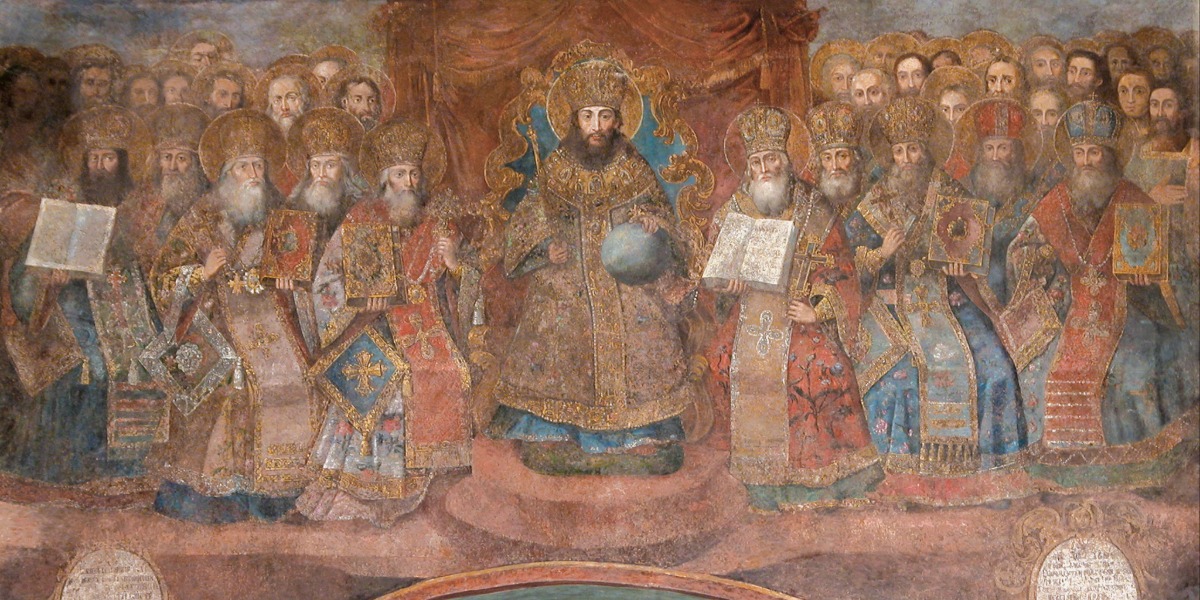
The first ecumenical council of the church, consisting of bishops and leaders from across the ancient world, convened in Nicaea in AD 325 to settle disputes over the very substance of Peter’s confession in Matthew 16: who is Jesus? What is his nature? In what way is he God’s Son? The council articulated a confession, a rule drawn from the plenary witness of the canon of Scripture, that summarized their answer to the question. The Nicene Creed, expanded in AD 381 at the fourth ecumenical council in Constantinople, offers a consensus grammar on the what Scripture says about who God is, his work in history, and especially the significance of Christ’s person and work in the incarnation and sending of the Holy Spirit.
Some may be quick to say that we do not find the creed in Scripture. It is a humanly constructive system laid over the top of Scripture. But to see the creed as something untethered from Scripture is to miss how thoroughly faithful it is to the whole of the canon, and how instructive it is in how to read the canon. The creed begins, like Genesis, with the recognition that God is the maker of all that is, “heaven and earth, all things visible and invisible.” Yet it also begins Christianly, which is to say trinitarianly, naming God as “the Father Almighty,” as the “only-begotten Son of God”, and as “the Holy Spirit, the Lord and Giver of Life.” The canon is given by God to reveal God, which culminates in the Christ event by God showing himself to be Father, Son, and Spirit, speaking and acting that we might know him as he is. To recognize this is to show that we have understood the question presented to Peter, and that we can answer in the grammar of God’s speech about himself—that we get the message.