

Biographical Sketch
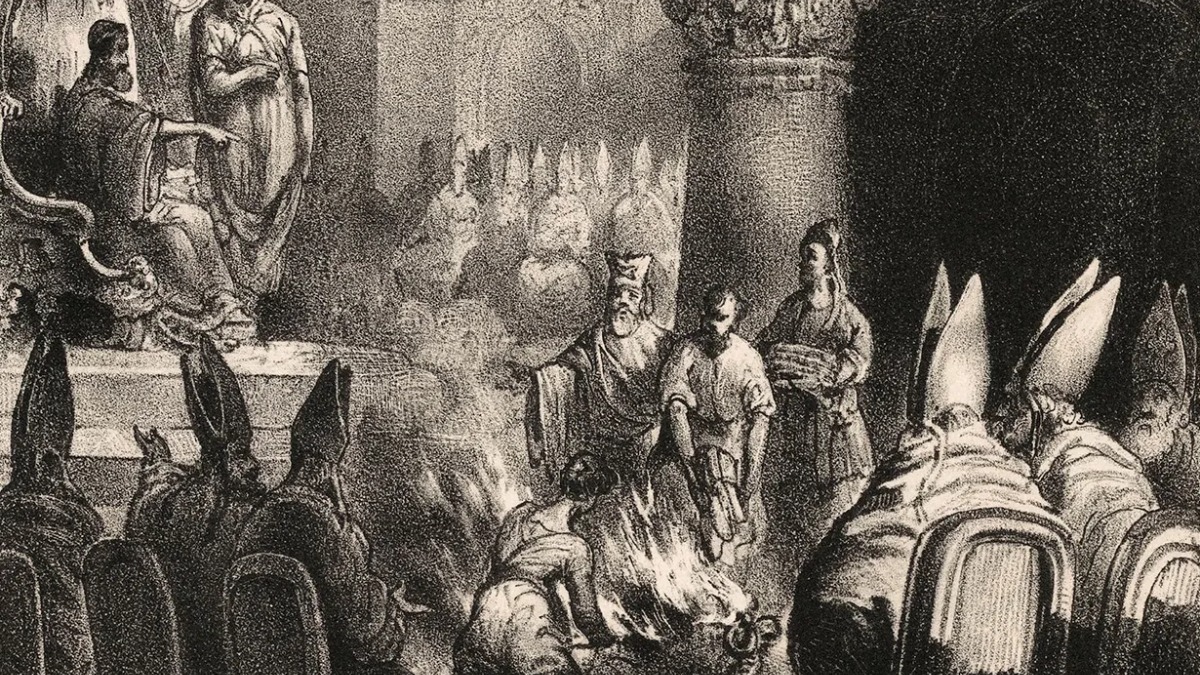
From a young age, Athanasius of Alexandria (ca. 295–373) was close to his predecessor bishop, Alexander of Alexandria (312–328). While many details remain uncertain and disputed, he would have been familiar with the dispute between Alexander and the presbyter under his jurisdiction, Arius, whom Alexander condemned at the Council of Alexandria in ca. 321.1 Athanasius accompanied Alexander to the Council of Nicaea convened by Emperor Constantine during June and July of 325. His role and access would have been limited as he was only a deacon at the time.
The record of Athanasius goes quiet until a couple of months after Bishop Alexander died on April 27, 328, when Athanasius was elevated from deacon to Bishop of Alexandria. Although Alexander nominated Athanasius before his death, Athanasius was forced to contend for his office. This was the setting in which he penned his most magisterial, two-part theological treatise, Against the Nations-On the Incarnation (Contra Gentes/De Incarnatione).2
Athanasius would serve as bishop for forty-six years, though his tenure was extremely turbulent. He died on May 2, 373, less than a decade before the Council of Constantinople carried forward the Nicene faith in a manner that would honor Athanasius’s legacy as a champion of the Nicene Creed. Both Basil of Caesarea and Gregory of Nazianzus celebrate Athanasius. Not even ten years after his death, Gregory celebrated his conformity to Christ, praising him because he “embraced virtue in its entirety”3 and calling him the “pillar of the Church”.4
Exiles
In the wake of the Council of Nicaea, which was called to overcome a controversy associated most notably with the Church in Alexandria, the influential episcopal see of Alexandria was contested, facing great scrutiny and many challenges. Despite his forceful influence and positive reception by the likes of the Cappadocian Fathers, while Bishop of Alexandria, Athanasius was exiled five times (amounting to about 17 years of disruption).5
(1) The Emperor Constantine first exiled Athanasius to Trier in the fall of 335 due to several factors, one of which was Athanasius’s refusal to observe the restoration of Arius at the 335 synod of Jerusalem. Two years later, a few months after Constantine’s death, Athanasius would return. At this time, Athanasius bound himself to the legacy of the Council of Nicaea in opposition to what he had described as the resurgence of “Arianism.”6
(2) When Athanasius opposed cooperation between Melitians and Arians, eastern bishops (including Eusebius of Nicomedia) deposed Athanasius twice in two separate councils at Antioch and, with the help of eastern Augustus, Constantius, sought Athanasius’s removal. In the spring of 339, they appointed Gregory of Cappadocia as the Bishop of Alexandria in his place.7 Meanwhile, Athanasius evaded arrest and departed for Rome where he would compose his Discourses against the Arians. While there, Athanasius gained favor with western Augustus, Constans, who would convince his brother in the East, Constantius, to allow Athanasius’s return in 346 after Gregory died. Constantius would consolidate power after the death of Constans in 350, condemning Athanasius in Arles (353) and then exiling various western bishops.
(3) In 356, Athanasius relinquished his jurisdiction to George of Cappadocia as he was forced into exile for a third time. In response to the rise of the Heterousians, Aëtius of Antioch and Eunomius of Cyzicus, Athanasius would write several treatises in defense of the Nicene Creed. After the deaths of Constantius and George in 361, Athanasius returned to Alexandria in February 362. Athanasius promoted unity within the Alexandrian Church and beyond, sending an overture of Nicene unity to Christian leaders in Antioch.
(4) However, the year 362 was not yet complete when Emperor Julian the Apostate exiled Athanasius a fourth time. Fortunately, Emperor Jovian, who took Julian’s place in June 363, permitted his return in the fall of the next year.
(5) Athanasius’s final exile came at the hands of anti-Nicene emperor Valens. Athanasius was forced to hide within his own city from May 365 to February 366.
What is clear from Athanasius’s exiles is not only that he was displaced and his office under siege but also that he often redeemed the time by forging politically (e.g., Julius of Rome and Marcellus of Ancyra) and spiritually (e.g., Antony of Egypt) important relationships. He remained steadfast in his commitment to advancing the unity of the Church around the Nicene faith. It is not without reason that modern commentators have been critical of Athanasius and some of his antics, but John Behr rightly concludes that in many and various ways, “Nicene Christianity exists by virtue of his constancy and vision.”8
FOUR EMPERORS, FIVE EXILES · Gold coins of Constantine, Constantius II, Julian and Valens